Can I, and Should I, Contribute to a Roth IRA?

Depending on your circumstances, a Roth IRA can be one of the most valuable retirement savings vehicles available. Unlike traditional retirement accounts, a Roth IRA offers the potential for tax-free growth and tax-free withdrawals in retirement, making it an attractive option for individuals who expect to be in the same or a higher tax bracket later in life.
However, not everyone is eligible to contribute directly to a Roth IRA, and even if you are, that doesn’t automatically mean it’s the best choice for your financial situation. Understanding both the eligibility rules and the strategic considerations can help you make an informed decision.
Can I Contribute to a Roth IRA?
The answer depends primarily on two factors:
You must have earned income.
Your modified adjusted gross income (MAGI) must fall below the IRS income limits for direct Roth IRA contributions.
Earned income generally includes wages, salaries, bonuses, commissions, and self-employment income. Investment income alone does not qualify.
The IRS establishes annual MAGI thresholds that determine whether you can contribute the full amount, a reduced amount, or not contribute directly at all. These limits are adjusted periodically for inflation, so it’s important to verify the current year’s eligibility before making a contribution.
2026 Roth IRA Contribution Income Phase-Outs
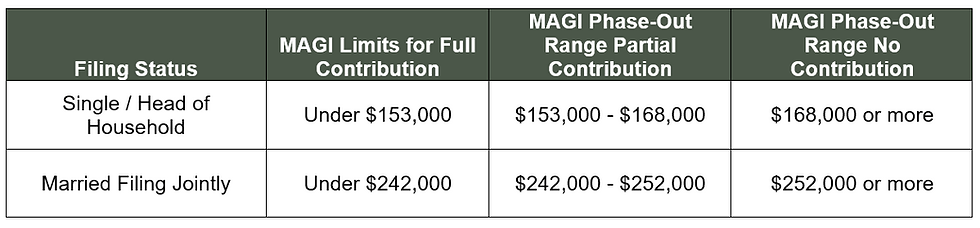
If your income exceeds the allowable limits, you may still have options, which we’ll discuss shortly.
Why Are Roth IRAs So Popular?
Roth IRAs were created in 1998 with the intent of boosting America's low household savings rates. The biggest advantage of a Roth IRA is simple: qualified withdrawals are completely tax-free. Because contributions are made with after-tax dollars, your investments have the opportunity to grow for decades without future federal income taxes on qualified distributions.
That creates several meaningful benefits:
Tax-free investment growth
Tax-free withdrawals in retirement
No required minimum distributions (RMDs) during your lifetime
Greater flexibility in retirement income planning
No Income in Respect of a Decent (IRD) tax for your heirs
Many investors underestimate how valuable tax-free growth can become over a 20 or 30-year investment horizon. Even modest annual contributions can compound into substantial retirement assets.
Should I Contribute to a Roth IRA?
Eligibility is only half the equation. The more important question is whether contributing to a Roth IRA makes sense for your overall financial plan. Here are a few situations where a Roth IRA may be particularly beneficial.
You Expect Your Tax Rate to Be Higher Later
If you’re early in your career or expect your income to increase significantly over time, paying taxes today at a lower rate may be advantageous. Instead of receiving a tax deduction now, you’re effectively pre-paying taxes in exchange for tax-free income later.
This strategy can be especially attractive for:
Young professionals
Medical professionals
Attorneys
Engineers
Executives with growing compensation
Business owners expecting future income growth
You Want More Tax Diversification
One of the biggest retirement planning mistakes is accumulating all retirement assets in tax-deferred accounts. If nearly all of your savings are in Traditional IRAs or 401(k)s, every withdrawal during retirement may increase your taxable income.
A Roth IRA creates tax diversification by giving you another “bucket” of money that can be withdrawn tax-free. Having multiple tax buckets allows retirees to better manage:
Federal income taxes
Medicare premium surcharges
Social Security taxation
Capital gains planning
Estate planning
Rather than being forced to take only taxable withdrawals, retirees can strategically combine taxable, tax-deferred, and tax-free assets to control what marginal tax bracket they fall in depending on their situation each year.
When a Traditional IRA May Make More Sense
A Roth IRA isn’t always the better choice. If you’re currently in one of your highest earning years and expect your retirement income to be significantly lower, receiving a tax deduction today through a Traditional IRA or Traditional 401(k) contribution may provide greater long-term value.
For example, someone in the 35% federal tax bracket today who expects to retire in the 22% bracket may benefit more from delaying taxes rather than paying them now. The long-term value comes in form of tax-rate arbitrage, as the after-tax value is greater when paying 22% later on instead of 35% today.
What If I Make Too Much Money?
Many high-income professionals assume they cannot benefit from a Roth IRA because their income exceeds the IRS contribution limits. Fortunately, that’s not necessarily true.
One widely used strategy is the Backdoor Roth IRA. A Backdoor Roth involves making a non-deductible contribution to a Traditional IRA and then immediately converting those funds into a Roth IRA.
While the strategy is permissible under current tax law, it must be executed carefully. Existing pre-tax IRA balances may trigger the IRS’s pro-rata rule, potentially creating unexpected tax consequences.
Because of these complexities, investors should coordinate with both their financial advisor and tax professional before implementing a Backdoor Roth strategy.
Don’t Forget Your Employer Retirement Plan
One common misconception is that contributing to a Roth IRA means you should stop contributing to your employer-sponsored retirement plan. In reality, many investors can benefit from doing both.
If your employer offers a matching contribution in a 401(k), it’s generally prudent to contribute at least enough to receive the full employer match before directing additional savings elsewhere. Employer matching dollars represent an immediate return on your contribution that is difficult to replicate through other investment strategies.
From there, the appropriate allocation between a Traditional or Roth 401(k), a Roth IRA, and taxable investment accounts depends on your income, tax situation, pre-retirement liquidity needs, retirement goals, and overall financial plan.
Common Roth IRA Mistakes to Avoid
Some of the most common Roth IRA mistakes include:
Contributing despite exceeding income limits
Missing the annual contribution deadline
Assuming a Roth IRA is always better than a Traditional IRA
Ignoring the tax implications of a Backdoor Roth conversion
Failing to invest the money after making the contribution
Overlooking beneficiary designations
A Roth IRA is only as effective as the investment strategy inside the account. Maintaining an allocation aligned with your long-term goals remains just as important as choosing the account itself.
The Bottom Line
A Roth IRA can be one of the most powerful tools available for building long-term, tax-efficient retirement wealth. For eligible investors, the combination of tax-free growth, tax-free withdrawals, and the absence of required minimum distributions offers flexibility that few other retirement accounts can match.
That said, the right decision depends on more than simply qualifying to contribute. Your current tax bracket, expected future income, retirement timeline, existing retirement accounts, and broader financial goals should all factor into the analysis.
For some investors, maximizing Roth contributions each year is a clear opportunity. For others, prioritizing traditional retirement accounts or implementing a Backdoor Roth strategy may be more appropriate.
The key is understanding how a Roth IRA fits into your overall financial plan and not just this year’s tax return.
Disclosure
RISE Investment Management, LLC ("RISE" or "RISE Investments") is an investment adviser registered under the Investment Advisers Act of 1940. Registration of an investment adviser does not imply any level of skill or training. This publication is solely for informational purposes and past performance is not indicative of future results. Any description of products, services, and performance results of RISE contained in this publication are not an offering or a solicitation of any kind. No advice may be rendered by RISE Investments unless a client service agreement is in place. Advisory services are only offered to clients or prospective clients where RISE Investments and its representatives are properly licensed or exempt from licensure. All of the information in this publication is believed to be accurate and correct as the date set forth. RISE does not have or accept responsibility or an obligation to update such information. Please note, this article is for education purposes and should not be treated as tax or legal advice. This article is not a substitute for legal or tax advice from your professional legal or tax advisor.