First Quarter 2026 Market Update and Outlook: Energy Sector on Center Stage

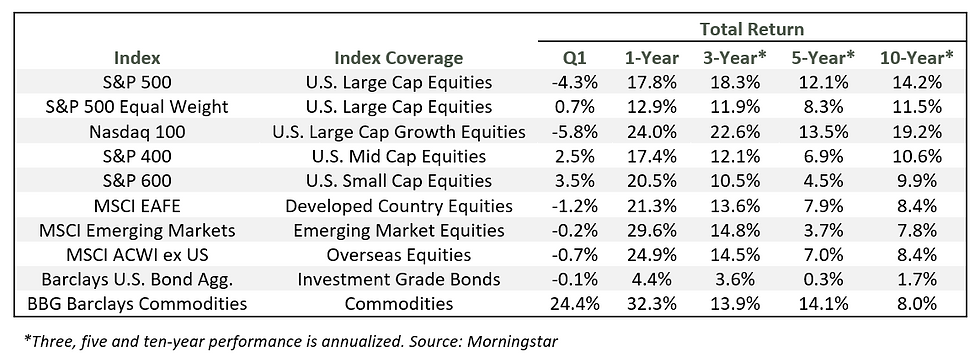
Equity performance broadened, with small cap and mid cap equities outperforming large cap equities.
Fixed income markets sold off as expectations for tighter monetary policy grew due to higher commodity prices, including energy.
The energy sector represents a core weighting in RISE client equity allocations.
First Quarter Update
Market volatility returned as uncertainty regarding artificial intelligence, private credit lending and the Iran conflict overshadowed the positive global economic momentum. Concerns of higher commodity prices have increased expectations for tighter monetary policy, as demonstrated by the recent uptick in the two-year treasury yield.

Higher interest rates disproportionately affect stocks that trade at higher price-to-earnings multiples, such as growth stocks. However, higher interest rates are not always negative for diversified investors. For instance, bond yields are more attractive for fixed income investors seeking to boost stable cash flow. Additionally, cheaper stocks such as value and dividend stocks have outperformed as capital has re-balanced to these areas of the stock market.
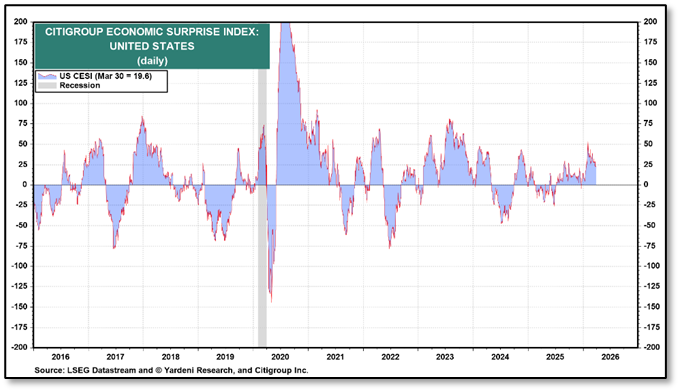
While the conflict in Iran has caused uncertainty to rise, this uncertainty is occurring with a backdrop of economic strength.
The Citigroup U.S. Economic Surprise Index calculates the difference between expected and actual economic data. This index is still in positive territory, suggesting better than expected economic growth.
Energy Sector Update
The Strait of Hormuz is a strategic global chokepoint that 20% of global oil supply passes through. At its narrowest point, the strait is 24 miles wide. Since the conflict began on February 28th, Iran effectively closed the strait to vessels transiting oil and other commodities. In February, there was a daily average of 129 ships passing through the strait. The daily average throughout March was six ships, representing a 95% drop in daily traffic [1].
The sharp increase in oil prices has led to concerns of a looming recession, especially given higher gas prices at the pump. However, the recent move in oil prices needs to be viewed in longer-term context. Current prices for West Texas Intermediate crude oil (i.e. U.S. oil) are well below levels experienced over the last two decades despite much higher economic activity today than 15 years ago.

Until recently, the energy sector has been an afterthought on Wall Street. While once a meaningful component of the S&P 500, the energy sector now makes up only 4.2% of the index. Today, energy companies are more disciplined with their capital allocation with a focus on returning cash to shareholders through share repurchases and dividends.
The energy sector has a higher weighting within value and overseas stocks. These market segments represent a core component of RISE clients' equity allocation.

Parting Thoughts
When looking past the headlines, the economic backdrop remains constructive and the broader market breadth improved over the quarter, with cheaper small and mid cap stocks outperforming and posting positive returns to start the year.
Going underappreciated for much of the past decade, the energy sector is now at the center of global attention. This serves as a reminder of why energy exposure should be treated as a strategic long-term allocation rather than an arena to speculate when pricing becomes more volatile.
Markets rarely move in straight lines, and the first quarter of the year was a relatively subtle proof point of that reality. When military conflicts break out, it is typical for stock market turbulence to rise amid initial uncertainty. However, as highlighted in a recent insight we published, history shows that market pullbacks resulting from military conflicts are typically short-lived and have minimal impact on long-term stock market resiliency.
Periods like this reinforce why we do not concentrate investment portfolios in a single theme or sector, and why patient, disciplined investing continues to be the most reliable path to long-term financial success.
As always, we are here if you have any questions and we look forward to connecting with you soon.
Sincerely,
The RISE Team
Footnotes
[1] Source: UN Trade and Development (UNCTAD), based on data provided by Clarksons Research Shipping Intelligence Network.
Disclosure
RISE Investment Management, LLC ("RISE" or "RISE Investments") is an investment adviser registered under the Investment Advisers Act of 1940. Registration of an investment adviser does not imply any level of skill or training. This publication is solely for informational purposes and past performance is not indicative of future results. Any description of products, services, and performance results of RISE contained in this publication are not an offering or a solicitation of any kind. No advice may be rendered by RISE Investments unless a client service agreement is in place. Advisory services are only offered to clients or prospective clients where RISE Investments and its representatives are properly licensed or exempt from licensure. All of the information in this publication is believed to be accurate and correct as the date set forth. RISE does not have or accept responsibility or an obligation to update such information. This article is not a substitute for legal or tax advice from your professional legal or tax advisor.