Tax and Wealth Transfer Strategies for Affluent Illinois Families

Updated: Jul 9

What Makes Illinois' Tax Landscape Unique?
We designed this guide exclusively for Illinois residents with $1M+ in investable assets or an estate with near $4 million or greater in total value. If you own a business, real estate, or a significant investment portfolio, the unique tax landscape in the Land of Lincoln makes proactive planning essential.
Illinois is one of only a handful of states with its own estate tax. With an exemption threshold of just $4 million, many families who worked a lifetime to build their wealth are affected without realizing it. We have seen firsthand how a lack of awareness about Illinois’s estate tax, its non-portability between spouses, and its “cliff” estate tax structure can cost families hundreds of thousands of dollars or more that proper planning could have preserved.
This guide covers various strategies our team uses to help Illinois clients navigate these challenges; from structuring Credit Shelter Trusts that fully utilize both spouses’ exemptions, to tax-loss harvesting, Roth conversion strategies, and charitable giving vehicles that serve both your values and your tax picture. These are not theoretical concepts. Rather, they are the frameworks we implement for our Illinois-based clients.
What is RISE Investments?
If you have worked hard to build significant wealth, you already know that protecting and growing it requires more than good investments. It requires a strategy. One that accounts for taxes, legacy, and the unique challenges that come with living and building wealth here in Illinois.
At RISE Investments, we understand that your goals and concerns may go far beyond investment returns. You want to make the most of what you have built, minimize unnecessary tax erosion, and create a lasting legacy for the people and causes you care most about. That is exactly why we do what we do.
Founded in 2019, we were built from the ground up with a single purpose: to serve our clients with deeply personalized, conflict-free financial guidance. As a fiduciary, we are legally and ethically obligated to act in your best interest at all times. We are independent, which means we are never incentivized by product commissions or sales quotas. Our only incentive is your financial success. We believe this is the only way to truly serve clients, and it is the foundation that RISE is built on.
We created this guide specifically for Illinois residents because the tax landscape here in our home state is genuinely different and consequential. Illinois is one of only a handful of states with its own estate tax. With an exemption threshold of just $4 million, many families who worked a lifetime to build their wealth are affected without realizing it. We have seen firsthand how a lack of awareness about Illinois’s estate tax, its non-portability between spouses, and its “cliff” estate tax structure can cost families hundreds of thousands of dollars or more that proper planning could have preserved.
This guide covers the strategies our team uses to help Illinois clients navigate these challenges; from structuring Credit Shelter Trusts that fully utilize both spouses’ exemptions, to tax-loss harvesting, Roth conversion strategies, and charitable giving vehicles that serve both your values and your tax picture. These are not theoretical concepts. Rather, they are the frameworks we implement for our Illinois-based clients.
What Should You Expect from Your Wealth Manager?
As your wealth grows, so does the complexity of managing it well. An exceptional wealth manager is far more than a portfolio manager. They are a strategic partner that coordinates each dimension of your financial life into one cohesive plan. For Illinois families, this coordination is especially critical.
You may already have a financial team in place, and you may even have a financial plan in place. However, even strong plans can be subject to costly blind spots. When your outside professionals and advisors, such as your estate attorney, CPA, or insurance experts, should be involved, we coordinate seamlessly with them to treat your portfolio as a unique entity rather than a model to be applied.
Over $84 trillion worth of assets are expected to transfer between generations over the next two decades. We believe professional wealth management services are necessary for affluent families and their future generations to achieve financial continuity, a lasting legacy, and preservation of wealth for future generations.
At RISE, we proactively support our clients in four key areas.
Comprehensive Financial Planning
We build a complete picture of your financial life from income and expenses to assets, liabilities, goals, and timeline. Each aspect of your plan is carefully crafted and executed to achieve your best outcomes. We provide you with insights to understand the connections between your decisions and their impact on complex, interrelated questions. Our advisors develop personalized strategies tailored to the unique aspects of your wealth.
Investment Management
Customized and tailored investment solutions aligned with your specific goals and objectives, incorporating robust tax optimization and risk management techniques to minimize tax erosion and safeguard your investments. We manage our clients’ portfolios with a focus on the long-term, treating each client’s portfolio as a unique entity tailored to their specific goals.
Tax and Advanced Planning
From asset location strategy and tax-loss harvesting to Roth conversion modeling, business owner tax structures, and much more, we coordinate proactively with your CPA to minimize your Illinois and Federal tax burden every year.
Legacy and Estate Planning
Your legacy should reflect your values, not the state’s tax code. We work alongside estate attorneys to strategize and structure your wealth for inter-generational transfer, which may include Illinois Credit Shelter Trusts, ILITs, charitable giving vehicles, and business succession planning.
Why is Illinois Is One of the Most Challenging States for Affluent Wealth Transfer?
While the state's flat 4.95% income tax rate is straightforward, Illinois has quietly become one of the most-costly states in the nation for wealth transfer. This is largely due to it being one of 12 states (plus the District of Columbia) that imposes an estate tax, which is in addition to Federal estate taxes.
The result is that many Illinois families who may not think of themselves as "ultra-wealthy" still face a significant estate tax bill that could have been substantially reduced or eliminated with the right planning.

Illinois Estate Tax: What Every Affluent Resident Must Know
Being one of 12 states (plus DC) that imposes an estate tax, there are several features that set Illinois apart from both the Federal system and some other state estate taxes.
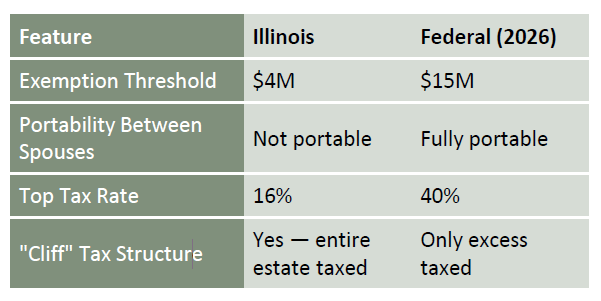
The Illinois 'Cliff Tax' Trap
Unlike the Federal estate tax, Illinois taxes your entire estate once it crosses the $4M threshold, not just the amount above $4M. This creates a dangerous 'cliff' effect. Without planning, crossing the $4M exemption threshold triggers tax on the full estate value.
Non-Portability Warning for Married Illinois Couples
Illinois's exemption is NOT portable between spouses. If one spouse dies with a $7M estate and leaves everything to the surviving spouse at death (a common default), the entire $7M is taxed at the death of the surviving spouse, resulting in approximately $565,6031 of Illinois estate taxes. Whereas, an optimally structured estate plan could have eliminated the tax entirely.
Illinois Estate Tax Rates and Calculation
Illinois uses a progressive estate tax rate schedule, ranging from 0.8% to 16%. The reality, however, is that it behaves in a regressive manner due to the previously referenced ‘cliff’ effect, disproportionately impacting moderate-sized estates over very large estates. This nuance makes the calculation of Illinois estate taxes complex, which stresses the importance of utilizing experts and specialized tools, such as the Illinois Attorney General’s estate tax calculator, to estimate a more accurate tentative tax liability.

While gifts made during your lifetime are not directly taxed by the state, they are considered when calculating the estate tax if they exceed the annual exclusion amount ($19,000 per recipient, $38,000 per recipient for married couples – 2026). This inclusion can materially impact the estate’s Illinois tax liability.
What are Strategies to Minimize Illinois Estate Tax?
Planning for Illinois estate tax can be highly advantageous. Unlike Federal estate tax, which requires an estate larger than $30M to trigger taxes, Illinois's $4M threshold means affluent families need these strategies.
The following strategies can dramatically reduce or even eliminate your Illinois estate tax exposure.
Strategy 1: Credit Shelter Trust (Bypass Trust)
This is the single most important planning tool for married couples in Illinois. Since Illinois's exemption is not portable between spouses, couples must proactively use both $4M exemptions through trust structuring.
At the first spouse's death, rather than passing assets directly to the surviving spouse (which wastes the decent spouse’s exemption), assets up to $4M are directed into an irrevocable Credit Shelter (or Bypass) Trust. The surviving spouse can still benefit from trust income generated by those assets during their lifetime.
This funding structure uses the first spouse’s Illinois exemption to shelter those assets from estate taxes. Any value above the $4M in the first spouse’s estate can still go to the surviving spouse - outright or through a marital trust.
The excess amount that goes to the surviving spouse or a marital trust won’t be taxed at the first death, as the marital portion qualifies for the estate tax marital deduction. At the second spouse’s death, the Credit Shelter Trust assets pass to heirs outside of the taxable estate.

Strategy 2: Lifetime Gifting to Reduce Your Illinois Taxable Estate
Illinois only counts Federally-reported taxable gifts when calculating the Illinois estate. This creates a significant planning opportunity to substantially reduce the size of one’s estate during their lifetime through strategic gifting.
The annual gift tax exclusion allows you to gift up to $19,000 per recipient per year. These gifts are completely excluded from Federal and Illinois estate calculations. In addition, a married couple can utilize a concept referred to as “gift-splitting” to gift up to $38,000 per recipient per year without triggering any gift or estate taxes. Some common examples of how couples utilize lifetime gifting to reduce the size of their estate are:

Strategy 3: Irrevocable Life Insurance Trust (ILIT)
Life insurance proceeds paid directly to a beneficiary are included in your taxable estate for Illinois purposes. By purchasing a life insurance policy in an ILIT, the policy is removed from your estate entirely. This is especially powerful for Illinois residents because the death benefit passes outside the estate, preserving the full $4M Illinois estate exemption for other assets.
The ILIT can be funded to specifically cover your projected Illinois estate tax liability or any amount that is lesser or greater. Just like if the insurance policy was held directly, the death benefit passes to beneficiaries tax-free.
When utilizing this strategy, married couples most commonly purchase dual life insurance policies, which insures both spouses and does not result in a death benefit payout until the death of the second spouse.
Strategy 4: Charitable Remainder Unitrust (CRUT)
CRUTs are charitable and irrevocable gifting vehicles that serve several purposes for Illinois residents:
Reduce the size of the estate by the amount contributed to the trust.
If contributing appreciated assets, the grantor is no longer subject to capital gains tax on the appreciation of the assets contributed.
Grantor receives an immediate tax deduction for the present value of the projected remainder interest in the trust, which transfers to a charity or foundation at the end of the trust’s term.
The CRUT beneficiary (can be same person as the grantor) receives years, or a lifetime, of income payments from the trust. 5% or more of the fair market value of the trust’s assets can be distributed as income to the beneficiary each year.
Multiple contributions can also be made to a CRUT over time and CRUTs can be structured to provide the beneficiary with annual income over a specified term (up to 20 years) or for their lifetime. However, the charitable remainder interest must be at least 10% of the total assets contributed. The appreciated assets contributed to the CRUT can be sold tax-free and reinvested in a diversified portfolio. If the diversified portfolio grows over time, so does the dollar amount of income distributed to the beneficiary each year, which doubles as an inflation hedge for the beneficiary.

Strategy 5: Grantor Retained Annuity Trust (GRAT)
A GRAT allows the transfer of appreciation of assets to heirs with minimal or zero gift tax. After contributing assets to the GRAT, the grantor receives annuity payments back for a term of years, and anything that grows above the IRS hurdle rate (the Section 7520 rate) passes to heirs free of estate and gift tax. In a rising-asset environment, GRATs can move significant wealth out of the Illinois taxable estate efficiently.
Strategy 6: Qualified Personal Residence Trust (QPRT)
For Illinois residents with valuable primary or vacation homes, a QPRT allows you to transfer your home to your heirs at a deeply discounted gift tax value, while you continue to live there for a set term, such as for the remainder of you and your spouse’s lives. Given Illinois's high property values, this strategy can remove a substantial asset value from your taxable estate.
Strategy 7: Out-of-State Asset Migration
Illinois only taxes the Illinois-situs portion of a non-resident's estate. For residents considering relocation, establishing domicile in a state with no estate tax (e.g., Florida, Texas, Nevada) before death eliminates Illinois estate tax on personal property entirely. Real estate located in Illinois remains subject to Illinois estate tax regardless of domicile, so real estate restructuring may also be warranted.
Income Tax Planning
Illinois's 4.95% flat income tax is relatively simple in structure, but affluent residents still face meaningful opportunities to reduce their effective Illinois tax burden. When combined with Federal tax strategy, these approaches can significantly improve after-tax income and investment returns.
Take Advantage of Illinois's Generous Retirement Income Exemption
Illinois fully exempts nearly all retirement income from state tax. This includes distributions from 401(k) plans, traditional and Roth IRAs, pension income, and Social Security benefits. This can be utilized by retirees to shape smart retirement income-shifting strategies.
Roth Conversion Strategy: Converting Traditional IRA assets to Roth IRA assets
triggers income taxes at the Federal level but is exempt from Illinois state income tax. The primary benefit of a Roth conversion is tax-free growth and tax-free distributions in retirement. If you expect to be in a lower Federal tax bracket in certain years, that is the optimal time for a Roth conversion. Roth conversion strategies can be executed over multiple years to control tax implications by converting only the amount of your Traditional IRA assets each year that “fills up” your prevailing or target tax marginal Federal tax bracket. Unlike a Traditional IRA:
Roth IRAs are not subject to Required Minimum Distributions during the owner’s lifetime
Roth IRA beneficiaries are generally not subject to Income in Respect of a Decedent (IRD) taxes
Pre-Retirement Deferrals: Deferring ordinary income through pre-tax retirement account contributions will result in greater tax-deferred growth and retirement distributions from those accounts being exempt from Illinois tax income taxes.
Capital Gains and Investment Income
There is no preferential capital gains rate at the state level, as Illinois taxes capital gains as ordinary income at the flat 4.95% rate. This means:
Tax-loss harvesting can be particularly valuable in Illinois. Realized losses offset gains that would otherwise face both Federal capital gains tax and the 4.95% Illinois rate.
Donating appreciated securities to a Donor-Advised Fund (DAF) avoids both Federal and Illinois capital gains entirely; a dual benefit for Illinois residents.
Income Sequencing in Retirement
Because Illinois exempts all retirement plan income, the order in which you draw from different accounts directly impacts your Illinois tax liability. A well-designed withdrawal strategy keeps as much income as possible in Illinois-exempt categories.
Use Social Security income freely, which is fully exempt from Illinois state income tax.
Draw from IRA and 401(k) first in early retirement (exempt from Illinois) while Roth accounts continue to grow.
Roth distributions are completely tax-free Federally and exempt from Illinois income tax. Reserve Roth IRA distribution for later in retirement and highest-need years.
Illinois 529 College Savings Plans
Illinois offers one of the most generous 529 deductions in the country. Contributions to Illinois's Bright Start or Bright Directions 529 plans are deductible from Illinois taxable income up to $10,000 per taxpayer ($20,000 for married couples filing jointly) per year. For affluent families funding multiple children's education accounts, this deduction alone can save $495–$990 per year in Illinois taxes.
Qualified Charitable Distributions (QCD)
For charitably inclined individuals age 70½ or older, QCDs are one of the most underutilized tax-efficient charitable gifting strategies. A QCD allows each individual taxpayer to transfer up to $111,000 per year directly from your IRA to a qualified charity (2026), with the distribution excluded from your taxable income entirely.
Unlike a standard charitable deduction, which only benefits you if you itemize, the QCD reduces your adjusted gross income at the source, meaning it delivers a tax benefit regardless of whether you take the standard deduction.
For affluent families, this distinction matters enormously. A lower AGI can reduce Medicare premium surcharges, minimize exposure to the 3.8% Net Investment Income Tax, and keep more of your Social Security benefits from being taxed at the Federal level.
Footnotes
[1] Source: Illinois Attorney General Decedents Estate Tax Calculator
Disclosure
RISE Investment Management, LLC ("RISE" or "RISE Investments") is an investment adviser registered under the Investment Advisers Act of 1940. Registration of an investment adviser does not imply any level of skill or training. This publication is solely for informational purposes and past performance is not indicative of future results. Any description of products, services, and performance results of RISE contained in this publication are not an offering or a solicitation of any kind. No advice may be rendered by RISE Investments unless a client service agreement is in place. Advisory services are only offered to clients or prospective clients where RISE Investments and its representatives are properly licensed or exempt from licensure. All of the information in this publication is believed to be accurate and correct as the date set forth. RISE does not have or accept responsibility or an obligation to update such information. Please note, this article is for education purposes and should not be treated as tax or legal advice. This article is not a substitute for legal or tax advice from your professional legal or tax advisor.